
SUGGESTED
Publications
Publications
14 August 2026
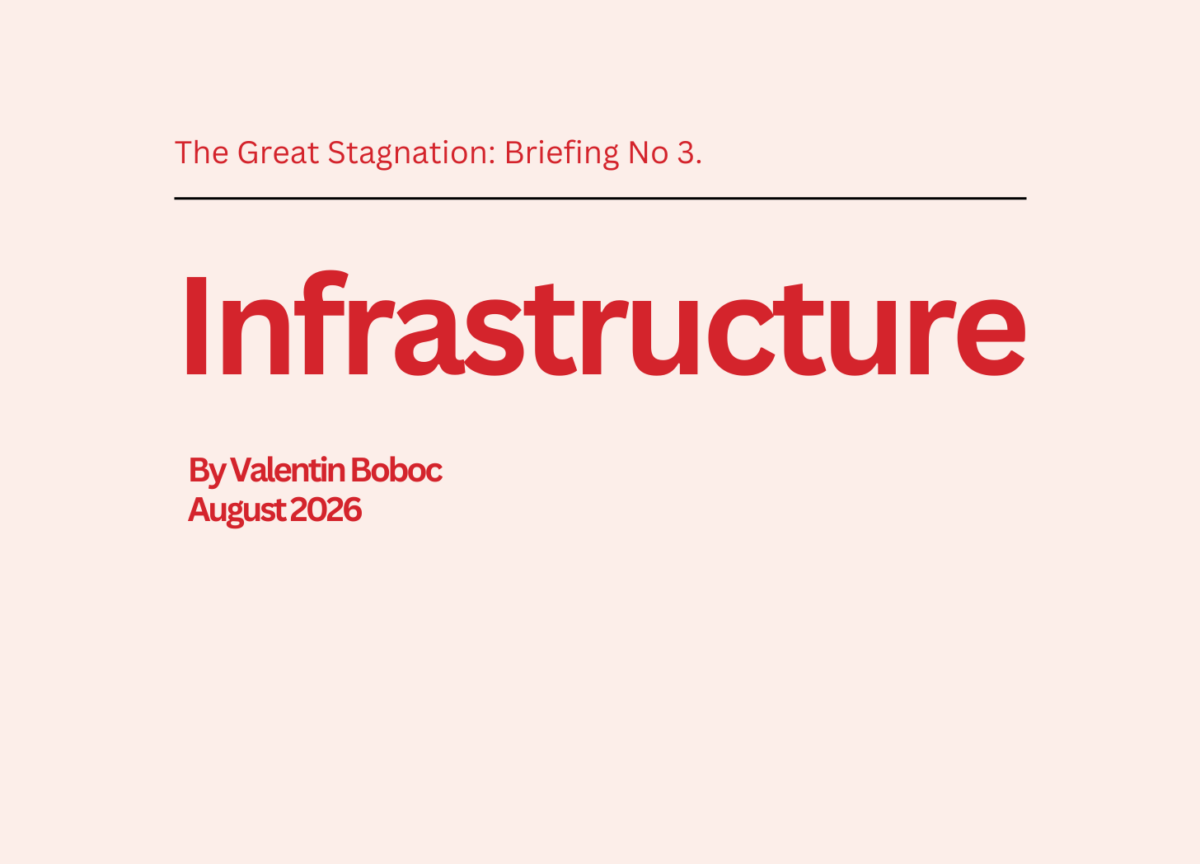
https://iea.org.uk/wp-content/uploads/Valentin-Boboc-Infra-Briefing-Great-Stagnation-3.pdf
This publication was made possible through the support of grant [#63661] from the John Templeton Foundation. The opinions expressed in this publication are those of the author(s) and do not necessarily reflect the views of the John Templeton Foundation.
Summary
- Successive governments have acknowledged that a lack of modern infrastructure is a significant impediment to economic growth in Britain.
- This is not a problem created by an unwillingness to spend public funds. Britain spends as much on infrastructure as its peers but receives measurably less. HS2 Phase 1, at roughly £470 million per route-kilometre, is the most expensive high-speed railway in any international database. British construction productivity fell by 0.6% a year between 1997 and 2019 whilst the wider economy grew by 2.8%.
- Every French city with a population above 150,000 has a tram, light rail or metro; around 30 British towns and cities of comparable size have none.
- Not building infrastructure also comes with costs, and these accumulate over time. The decision to cancel the Birmingham to Manchester leg of HS2 will have forgone, it is estimated, benefits worth somewhere between £0.6 and £1.3 billion a year to the economy of Greater Manchester alone.
- Development by right rather than by permission, narrower grounds for judicial review of planning decisions, procurement open to international competition, and land value capture on development could be part of a package that would boost productivity in infrastructure projects and replace the state’s monopoly of risk with hard budget constraints.
This publication was made possible through the support of grant [#63661] from the John Templeton Foundation. The opinions expressed in this publication are those of the author(s) and do not necessarily reflect the views of the John Templeton Foundation.
SHARE


