
IEA Research — 2026
British Attitudes to Economic Growth
A major poll of 3,001 British voters examines why Britain's economy has underperformed, what the public believes is holding it back, and what it will take to build a mandate for reform.
Public Priorities
Britons overwhelmingly want a stronger focus on growth
Support for prioritising economic growth is overwhelming. Very few voters believe the country is already wealthy enough, and only a small minority remain unsure.
Freshwater Strategy poll for the IEA, n=3,001 UK voters, January 2026. Q: "Which of the following comes closest to your view?"The Reform Mandate
Brits back free-market solutions to kickstart growth
When asked what would actually grow the economy, the public's instincts are predominantly supply-side. Large majorities back cutting energy costs, reducing taxes, and easing planning restrictions — a set of priorities that maps closely on to a free-market reform agenda. Policies that add costs or expand state control are widely seen as harmful.
Freshwater Strategy poll for the IEA, n=3,001 UK voters, January 2026. Q: "For each of the following actions, please indicate whether you think it would lead to growth, contraction or make no impact on the UK economy?"The Growth Gap
Strong support, weak understanding
Britons overwhelmingly want growth — but most cannot define it clearly, and many doubt it will ever reach them personally.
"I don't think I've ever seen real economic growth — to know what it actually feels like or looks like."
Younger male voter — Freshwater Strategy focus group for the IEA, February 2026
The Wealth Gap
The UK ranks 21st globally in GDP per capita
The average Briton is significantly poorer than the average person in Switzerland, Singapore, the United States, Australia, and Germany. Most Britons did not realise this was the case.
GDP per capita projections (current USD). Source: IMF World Economic Outlook DataMapper — imf.org/external/datamapper/NGDPDPC@WEOPerception vs Reality
Brits dramatically overestimate the UK’s position
When asked to rank the UK against other countries and US states, the gap between what people believe and what is actually true is stark — and the reaction to the truth is one of shock and embarrassment.
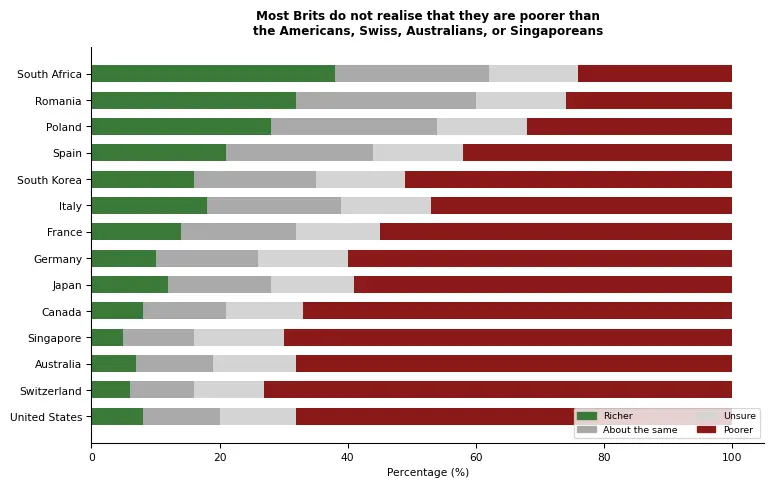
Source: Freshwater Strategy poll for the IEA, n=3,001 UK voters, January 2026; IMF World Economic Outlook DataMapper
Brits place the UK 7th wealthiest among US states, believing it sits comfortably above most of America's 50 states in GDP per capita.
Freshwater Strategy poll for the IEA, n=3,001 UK voters, January 2026The UK ranks behind every single US state — including Alabama, Mississippi, and Arkansas. Over a quarter of respondents described themselves as "shocked" upon learning this.
IMF World Economic Outlook DataMapper — imf.org/external/datamapper/NGDPDPC@WEO"It's kind of shocking to think, actually, we're quite lower down than expected."
Younger female voter — Freshwater Strategy focus group for the IEA, February 2026
The Kitchen Sink
What Brits think is holding back growth
The public agrees with a wide range of explanations for stagnation — from supply-side constraints to statist remedies. This reveals both the challenge and the opportunity for advocates of market-oriented reform.
Freshwater Strategy poll for the IEA, n=3,001 UK voters, January 2026. Q: "To what extent do you agree or disagree that each of the following is preventing the UK economy from growing?""Since both pro-growth and anti-growth policies are popular, the priority is not simply making the case for growth. It is demonstrating why bad policy has failed."
IEA analysis — British Attitudes to Economic Growth, 2026
Who are the British public?
Six growth segments of Britain
The research identifies six distinct segments shaped by lived experience, financial position, and beliefs about fairness and opportunity. Support for growth is high across all — but conditional, fragile, and filtered through social position.
Higher-income, degree-educated, London-based homeowners. The only segment with a consistently positive economic outlook.
Working-age, mid-income, Midlands and Wales. Pro-growth in principle but demanding evidence it will benefit them, not just businesses.
18–34, lower income, privately renting. Open to growth but not yet convinced it will work for them. Housing is their central concern.
Older, female, outright homeowners in southern England. Support growth as a means of maintaining stability and funding public services.
35+, Reform-leaning, the most uniformly negative group. Connect growth to lower taxes and a system that rewards hard work.
Lower income, insecure work, Midlands and Wales. Support growth only if it clearly improves their lives without adding costs.
All poll data: Freshwater Strategy for the IEA, online survey of n=3,001 UK voters, 13–18 January 2026. Data weighted to be nationally representative. Margin of error ±1.8% for topline results. Focus groups: four online sessions (n=27) conducted 25–26 February 2026 across England and Wales. GDP per capita data: IMF World Economic Outlook DataMapper (imf.org).